
Montgomery County Projected Release Meaning
“Projected” is not one Georgia record field. At Montgomery County Jail, a date may depend on bond, a local sentence, time-served credit, a court order, or a hold. At Montgomery State Prison, GDC tracks sentence information and maximum prison timing. The Parole Board uses Tentative Parole Month, or TPM, for possible parole timing. Actual release occurs only after the legal authority exists and the agency completes its checks.
A pretrial detainee generally has no fixed sentence-based release date. A bond event can create a release path, but another detainer may prevent exit. A sentenced inmate has a computed term, yet parole, credits, misconduct, programs, and sentence corrections can affect the public expectation.
| Term | What it means |
|---|---|
| County jail date | Local custody timing based on bond, court authority, sentence, and holds |
| Maximum release date | State sentence expiration or max-out timing |
| TPM | Month for final parole review and possible release-date setting |
| Parole release date | Actual approved release to parole after conditions are met |
| Discharge | Completion of the controlling custody or supervision obligation |
Find Montgomery County Projected Dates
Start with facility and sentence type. Montgomery County Jail and Montgomery State Prison are separate institutions. GDC is strong for state-sentenced people, but it is not a full county booking or bond file. The sheriff and local courts control the county path.
- Identify the last known facility and whether the person is pretrial or sentenced.
- For Montgomery County Jail, ask the sheriff for the booking, release calculation, release reason, and any transfer. Check the sentencing or bond court record.
- For state custody, open GDC Find an Offender and accept its disclaimer.
- Use a GDC ID or case number when known. Otherwise search the name and compare identity details.
- Select Montgomery State Prison as most recent institution or Montgomery County as conviction county when those facts fit.
- Use active and inactive scope as needed, and review the individual record rather than a summary row.
- For parole timing, use the Board's TPM lookup explanation and lookup tool.
- Verify disputed timing with GDC Inmate Records and Information or the local records office.
The broader Montgomery County release search explains court, sheriff, federal, and transfer checks when the custody source is uncertain.
Georgia PIC and Montgomery Releases
Georgia's documented state-prison adjustment is Performance Incentive Credit, or PIC. GDC says an eligible offender can accumulate up to 12 PIC points and potentially receive one to twelve months off a TPM or maximum release date. Points may come from a case plan, education or vocational improvement, and detail or work assignments. PIC is not an automatic reduction for each Montgomery State Prison inmate.
General parole eligibility is addressed in O.C.G.A. Section 42-9-45. It describes eligibility after six months or one-third of misdemeanor sentences, whichever is greater, and after nine months or one-third for many felony sentences, subject to exceptions. Eligibility means the Board may consider parole. It does not promise a TPM or release.
O.C.G.A. Section 17-10-6.1 governs serious violent felonies and mandatory prison or parole limits. It prevents a broad claim that every state prisoner follows ordinary one-third eligibility. No official Montgomery County local good-time or weekend-release policy was found, so local sentence credit must be confirmed with the sheriff and sentencing court.
Changes to Montgomery Release Dates
Dates change when the underlying legal record or agency decision changes. A new screen result can be more current than an old letter, but even a current TPM remains tentative. Read the label and ask which office made the change.
| Factor | Possible effect | Confirm with |
|---|---|---|
| Court order or corrected credit | Changes sentence calculation | Sentencing court or jail |
| Bond posted or revoked | Creates or removes a county release basis | Magistrate Court and sheriff |
| Hold or detainer | Blocks release or causes transfer | Holding and receiving agencies |
| PIC | May advance TPM or MRD | GDC and Parole Board |
| Conduct or program condition | May postpone or cancel parole timing | GDC and Parole Board |
| Parole review | May grant, deny, advance, or alter timing | Parole Board |
| Facility transfer | Changes location, not necessarily sentence | GDC or receiving agency |
The Board says misconduct often leads to postponement or cancellation, while strong conduct and rehabilitative work can advance a TPM by a few months. It can reconsider a prior decision up to the release date.
Confirm Montgomery County Release Timing
A county jail date should be checked with the Montgomery County Sheriff's Office at 208 East Broad Street, Mount Vernon, GA 30445, 912-583-2521, and with the court record that supplied the authority. Ask whether the answer is a planned date, an actual release, or a transfer. For state prison timing, GDC tells search users to verify through Inmate Records and Information at PO Box 1529, Forsyth, GA 31029.
Georgia VINE can add a notice when a participating feed reports release or transfer. Register through the Montgomery County VINE inmate check, then keep the agency confirmation step. VINE is not a historical sentence ledger and does not replace a court order or corrections record.
If parole is involved, distinguish TPM lookup from post-release parolee status. DCS supervises parolees and felony probationers in the community but does not set the TPM. Note: A person can leave one facility through transfer while remaining in custody under the same sentence.
Georgia's Montgomery Release Vocabulary
Georgia's public search terms are unusually specific. GDC provides “Max Prison Term Ending Next 15 Days” and “Released In The Past 15 Days” sentence-status filters. The first points toward approaching maximum-term timing. The second looks backward at a state release. Neither is a Montgomery County 24-hour or 72-hour jail list.
The Parole Board's TPM is a month for final review. It is conditioned on good conduct and may depend on treatment or other program requirements. At final review the Board may set a parole release date, but it can change its prior decision. Calling a TPM a guaranteed release date erases that distinction.
The GDC PIC program can affect a TPM or maximum release date by one to twelve months when points are awarded. The official PIC page is pictured below because it is the source for that Montgomery State Prison timing rule.
The Board's TPM page shows the state terminology used for tentative parole timing.
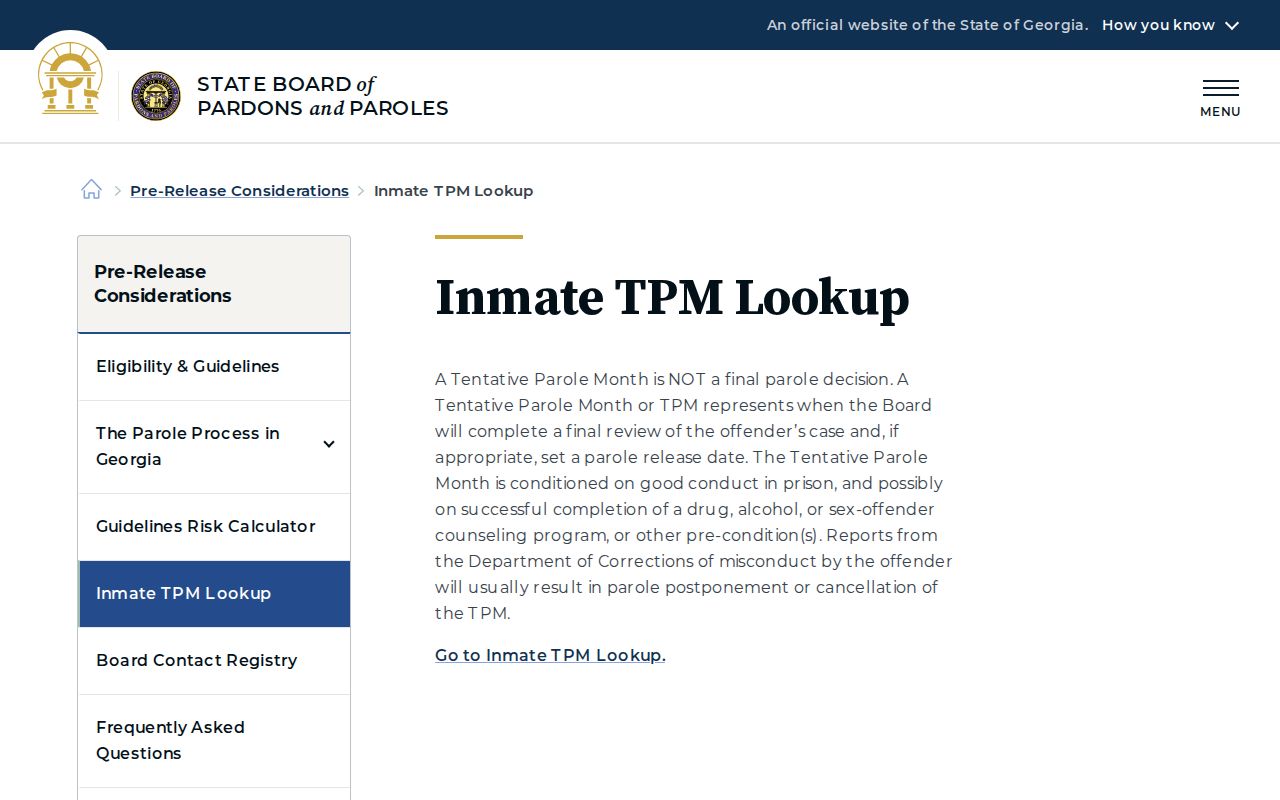
The image reinforces the core distinction: a TPM supports planning, but final review still controls whether a parole release date is set.
Montgomery State Release Search Fields
The GDC search form offers more than a name box, which matters when two people share a name or when the last known place is uncertain. A search may use first and last name, gender, race, age range, height, weight, eye color, hair color, or scars, marks, and tattoos. Known identifiers are stronger: the form accepts a GDC ID or case number. Montgomery County can also be selected as conviction county, while “MONTGOMERY STATE PRISON” and “MONTGOMERY COUNTY JAIL” appear as separate most-recent-institution choices. Those labels must not be treated as the same facility.
Scope changes the result set. “Only Active Offenders” is designed for people currently incarcerated in GDC. “Only Inactive Offenders” can locate a person who is no longer in GDC custody, and “Both Active and Inactive Offenders” helps when status is uncertain. The sentence-status menu includes life categories, a maximum prison term ending in the next fifteen days, and release in the past fifteen days. The form can also narrow by primary offense and choose a result list with or without photos. An individual record may display a photograph automatically when one is available.
Read these fields as search aids, not promises. “Most recent institution” can describe the last reported GDC location without proving that the person walked out of that gate. A transfer can change the institution while the sentence continues. Likewise, a maximum term ending soon does not account for a new court order, detainer, sentence correction, or another legal hold that is not yet clear to the searcher. Open the individual record, compare identity and sentence details, and save the date and exact field label used.
GDC warns that its online search is provided as a convenience. When a date is disputed or needed in formal form, request verification from Inmate Records and Information at the Forsyth mailing address. For a local Montgomery County Jail calculation, the sheriff and sentencing court remain the correct offices because GDC's statewide form is not a complete county bond or time-served ledger.
Public Record Search
Sponsored Results